Ever wondered how companies ensure their financial statements are accurate and reliable? That’s where financial auditing comes in. It’s a crucial process that involves systematically examining a company’s financial records to verify their accuracy, compliance with regulations, and overall financial health. This process goes beyond simply adding numbers; it delves into the intricacies of a company’s operations, revealing a comprehensive picture of its financial standing.
Understanding financial auditing is key for investors, stakeholders, and anyone interested in the inner workings of the business world.
Financial audits are conducted by independent auditors who follow strict guidelines and standards. These audits can be internal, performed by a company’s own employees, or external, conducted by independent firms. The goal is to provide assurance that the financial information presented is a fair and accurate representation of the company’s financial position. This assurance is critical for making informed decisions, attracting investors, and maintaining public trust.
Definition of Financial Auditing
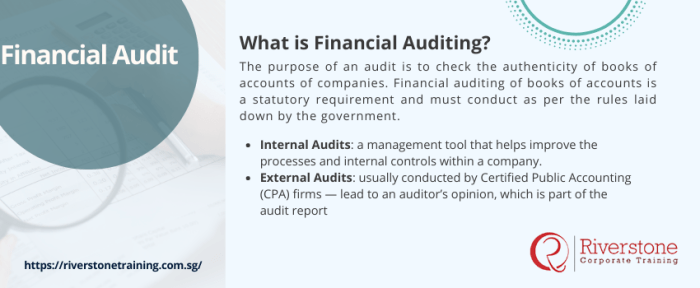
Financial auditing plays a crucial role in ensuring the accuracy and reliability of a company’s financial statements. It’s a systematic process that provides independent verification of a company’s financial health, offering assurance to stakeholders. This process is essential for maintaining trust and transparency in the financial markets.Financial auditing aims to provide reasonable assurance that a company’s financial statements are free from material misstatement, whether due to fraud or error.
In simpler terms, it’s like having an independent expert check a company’s books to make sure everything is accurate and fairly presented. This helps investors, creditors, and other stakeholders make informed decisions based on reliable financial information.
Types of Financial Audits
Different types of audits serve various purposes and cater to different stakeholders’ needs. Understanding these distinctions is key to appreciating the breadth of financial auditing.
- External Audits: These are conducted by independent, external audit firms and are usually required by regulatory bodies for publicly traded companies. The primary goal is to provide an opinion on the fairness and accuracy of the financial statements for external users like investors and creditors.
- Internal Audits: These are performed by an organization’s internal audit department. Their focus is on evaluating the effectiveness and efficiency of internal controls, risk management processes, and compliance with internal policies and regulations. They provide assurance to management and the board of directors.
- Operational Audits: While still related to financial information, operational audits go beyond the financial statements to examine the efficiency and effectiveness of an organization’s operations. This type of audit might look at things like supply chain management, production processes, or customer service to identify areas for improvement and cost savings.
Financial Auditing vs. Accounting
While closely related, financial auditing and accounting are distinct disciplines. Accounting focuses on the recording, classifying, summarizing, and interpreting of financial transactions. It is the process of creating the financial statements. Auditing, on the other hand, is the independent examination of those financial statements to ensure their accuracy and reliability. Accountants create the data; auditors verify its integrity.
Think of accounting as building a house, and auditing as inspecting the house for structural soundness and compliance with building codes. Accountants are responsible for the financial records, while auditors provide an independent assessment of those records.
The Auditing Process
A financial audit is a systematic and independent examination of an organization’s financial statements. The process involves a detailed review of accounting records, internal controls, and financial transactions to provide reasonable assurance that the statements are fairly presented and free from material misstatement. This assurance is crucial for stakeholders, including investors, creditors, and regulatory bodies, who rely on the accuracy and reliability of financial information for decision-making.The steps involved in a financial audit are iterative and often involve feedback loops.
While the exact sequence might vary slightly depending on the specific circumstances and the size of the organization, a typical audit follows a structured approach.
Stages of a Financial Audit
The audit process can be broadly divided into several key stages. These stages ensure a comprehensive and methodical examination of the financial information.
| Stage | Description |
|---|---|
| Planning | This initial stage involves understanding the client’s business, identifying risks, and developing an audit plan. This includes determining the scope of the audit, the resources required, and the audit timeline. Risk assessment is a crucial part of this phase. |
| Fieldwork | This is the most time-consuming stage, involving the collection and testing of audit evidence. This includes examining accounting records, performing analytical procedures, and conducting interviews with management and staff. Auditors may also perform physical inventory counts or observe internal control procedures in operation. |
| Reporting | Once the fieldwork is complete, the auditors analyze the evidence gathered and prepare an audit report. This report communicates the auditor’s findings, conclusions, and opinions on the fairness of the financial statements. The report typically includes an opinion on whether the financial statements are presented fairly in accordance with generally accepted accounting principles (GAAP). |
The Auditor’s Role
The auditor’s role is critical in ensuring the reliability of financial information. Auditors act as independent and objective examiners, providing assurance to stakeholders. Their responsibilities include:
- Planning and conducting the audit in accordance with professional standards.
- Gathering and evaluating audit evidence.
- Identifying and assessing risks of material misstatement.
- Formulating an opinion on the fairness of the financial statements.
- Communicating findings and recommendations to management.
Key Documents and Information Used
Auditors utilize a variety of documents and information sources during the audit process to gather evidence and form their conclusions. These include:
- Financial statements (balance sheet, income statement, cash flow statement).
- General ledger and subsidiary ledgers.
- Supporting documentation for transactions (invoices, receipts, bank statements).
- Internal control documentation (flowcharts, policies, procedures).
- Minutes of board meetings.
- Contracts and agreements.
Flowchart of the Audit Process
| Planning Risk Assessment Audit Plan Development |
Fieldwork Evidence Gathering Testing of Controls Substantive Procedures |
Reporting Analysis of Evidence Audit Report Preparation Communication of Findings |
Post-Audit Activities Follow-up on Recommendations Documentation Archiving |
Auditing Standards and Regulations
Auditing standards and regulations provide a framework for conducting audits, ensuring consistency, reliability, and comparability of financial statements across different organizations and jurisdictions. These standards are crucial for maintaining public trust in the financial reporting process. Adherence to these standards is vital for auditors to produce high-quality audit reports and to avoid legal repercussions.
Generally Accepted Auditing Standards (GAAS)
Generally Accepted Auditing Standards (GAAS) are a set of guidelines established by the auditing profession to ensure the quality and consistency of audits. These standards provide a framework for auditors to plan and conduct audits, ensuring that the audit process is thorough and objective. Compliance with GAAS is essential for maintaining public confidence in the reliability of financial statements.
The principles underlying GAAS emphasize the auditor’s responsibility to be independent, objective, and competent in performing the audit. Failure to adhere to GAAS can lead to legal liabilities and reputational damage for the auditing firm.
Impact of Laws and Regulations on the Auditing Process
Various laws and regulations significantly influence the auditing process. For example, the Sarbanes-Oxley Act of 2002 (SOX) in the United States introduced stricter regulations for publicly traded companies, increasing the responsibility of auditors and enhancing corporate governance. Similar regulations exist in other countries, designed to protect investors and maintain the integrity of financial markets. These regulations often mandate specific audit procedures, documentation requirements, and internal control assessments, impacting the scope and complexity of the audit.
Non-compliance with these laws can result in severe penalties, including fines and imprisonment.
Comparison of Global Auditing Frameworks
Different countries and regions may adopt different auditing frameworks, though there is a significant degree of convergence. For instance, the International Standards on Auditing (ISAs), issued by the International Auditing and Assurance Standards Board (IAASB), are widely adopted globally, promoting consistency in auditing practices across jurisdictions. However, national regulatory bodies may still have their own specific requirements and interpretations of these standards, leading to some variations in application.
The differences often relate to specific legal and regulatory environments, as well as accounting standards used in each country. While the core principles remain similar, the specifics of implementation can differ.
Key Auditing Standards and Regulations
| Standard/Regulation | Description | Governing Body | Impact on Auditing |
|---|---|---|---|
| Generally Accepted Auditing Standards (GAAS) | A set of guidelines for conducting audits in the United States. | American Institute of Certified Public Accountants (AICPA) | Provides a framework for planning and conducting audits, ensuring quality and consistency. |
| International Standards on Auditing (ISAs) | Globally accepted auditing standards issued by the IAASB. | International Auditing and Assurance Standards Board (IAASB) | Promotes consistency and comparability of audits across jurisdictions. |
| Sarbanes-Oxley Act (SOX) | US legislation enhancing corporate responsibility and financial disclosures. | US Congress | Increased auditor responsibilities and stricter regulations for publicly traded companies. |
| European Union Auditing Directive | EU legislation harmonizing auditing standards within the European Union. | European Union | Aims to create a consistent regulatory framework for audits within the EU. |
Types of Audit Opinions
Financial statement audits culminate in an audit opinion, a formal statement expressing the auditor’s conclusion about the fairness of the financial statements. Understanding the different types of audit opinions is crucial for stakeholders to accurately assess the reliability of a company’s financial reporting. These opinions reflect the auditor’s assessment of the evidence gathered during the audit process.The four main types of audit opinions—unqualified, qualified, adverse, and disclaimer—each carry distinct implications for the users of the financial statements.
The choice of opinion depends on the extent and nature of any identified material misstatements or limitations in the scope of the audit.
Unqualified Audit Opinion
An unqualified audit opinion, also known as a clean opinion, is the most favorable outcome. It signifies that the auditor has concluded, based on sufficient appropriate audit evidence, that the financial statements present fairly, in all material respects, the financial position, results of operations, and cash flows of the entity in accordance with the applicable financial reporting framework (e.g., Generally Accepted Accounting Principles (GAAP) or International Financial Reporting Standards (IFRS)).
This means the financial statements are free from material misstatements. For example, a company with robust internal controls, accurate financial records, and full compliance with accounting standards is likely to receive an unqualified opinion. Stakeholders can have high confidence in the reliability and accuracy of the financial information presented.
Qualified Audit Opinion
A qualified audit opinion indicates that the auditor found some material misstatements in the financial statements, but these misstatements are not pervasive enough to affect the overall fairness of the presentation. The auditor will clearly describe the nature and extent of the identified misstatements in their report. For example, a company might receive a qualified opinion if a specific account balance is materially misstated, but the overall financial position remains fairly presented.
This means stakeholders should exercise caution and carefully consider the specific qualifications Artikeld in the audit report before relying on the financial statements.
Adverse Audit Opinion
An adverse audit opinion is the most critical. It signifies that the auditor has concluded that the financial statements are materially misstated and that these misstatements are pervasive, meaning they affect the overall fairness of the presentation. The financial statements are not presented fairly. This situation might arise if the company uses inappropriate accounting methods or has significant unrecorded liabilities.
For instance, if a company intentionally misrepresents its revenue to inflate its earnings, it could lead to an adverse opinion. Stakeholders should exercise extreme caution and seriously question the reliability of the information provided. The adverse opinion significantly damages the company’s credibility.
Disclaimer of Opinion
A disclaimer of opinion occurs when the auditor is unable to obtain sufficient appropriate audit evidence to form an opinion on the financial statements. This might happen due to significant limitations in the scope of the audit, such as the inability to access key financial records or significant uncertainty related to a material aspect of the business. For example, if a company refuses to provide the auditor with access to critical information, a disclaimer of opinion would likely be issued.
Stakeholders cannot rely on the financial statements as the auditor has not expressed an opinion on their fairness.
| Audit Opinion Type | Description | Example | Stakeholder Implications |
|---|---|---|---|
| Unqualified | Financial statements are fairly presented in all material respects. | Company with strong internal controls and accurate financial records. | High confidence in financial information; suitable for investment decisions. |
| Qualified | Financial statements are fairly presented except for specific material misstatements. | Material misstatement in a single account, but overall financial position remains fairly presented. | Caution is warranted; review the specific qualifications carefully. |
| Adverse | Financial statements are materially misstated and the misstatements are pervasive. | Intentional misrepresentation of revenue to inflate earnings. | Extreme caution; financial statements are unreliable; significant damage to company credibility. |
| Disclaimer | Auditor unable to obtain sufficient appropriate audit evidence to form an opinion. | Company refuses to provide auditor with access to key financial records. | Cannot rely on the financial statements; further investigation is necessary. |
In conclusion, financial auditing plays a vital role in maintaining the integrity of financial markets and ensuring accountability. From understanding the different types of audits to interpreting audit opinions, grasping the fundamentals of this process empowers individuals and organizations to navigate the complex world of finance with greater confidence. By ensuring transparency and accuracy in financial reporting, financial auditing ultimately contributes to a more stable and trustworthy economic environment.
Quick FAQs
What is the difference between an unqualified and a qualified audit opinion?
An unqualified opinion means the financial statements are fairly presented. A qualified opinion indicates some issues were found that didn’t materially affect the overall financial statements but require explanation.
Who typically hires an external auditor?
Publicly traded companies are generally required to have external audits. Privately held companies may choose to have them for various reasons, including attracting investors or obtaining financing.
How long does a financial audit typically take?
The duration varies greatly depending on the size and complexity of the company, but it can range from several weeks to several months.
What are the potential penalties for fraudulent financial reporting uncovered by an audit?
Penalties can range from fines and legal action against the company and individuals involved to reputational damage and loss of investor confidence.